Fancy listening to this as an audio? ^Enjoy
I’ve yet to work with a company that had partner attribution figured out. Not one.
They have partners. They have deals that partners touched. They have revenue that probably came through the channel. But when someone asks “what’s the ROI of our partner programme?” the room goes quiet, three people open three different spreadsheets, and the answer depends on who you believe.
The attribution problem isn’t that companies don’t care about measuring partnerships. It’s that they’re using the wrong model for their situation, or worse, they’re using no model at all and manually tagging deals based on whoever shouts loudest.
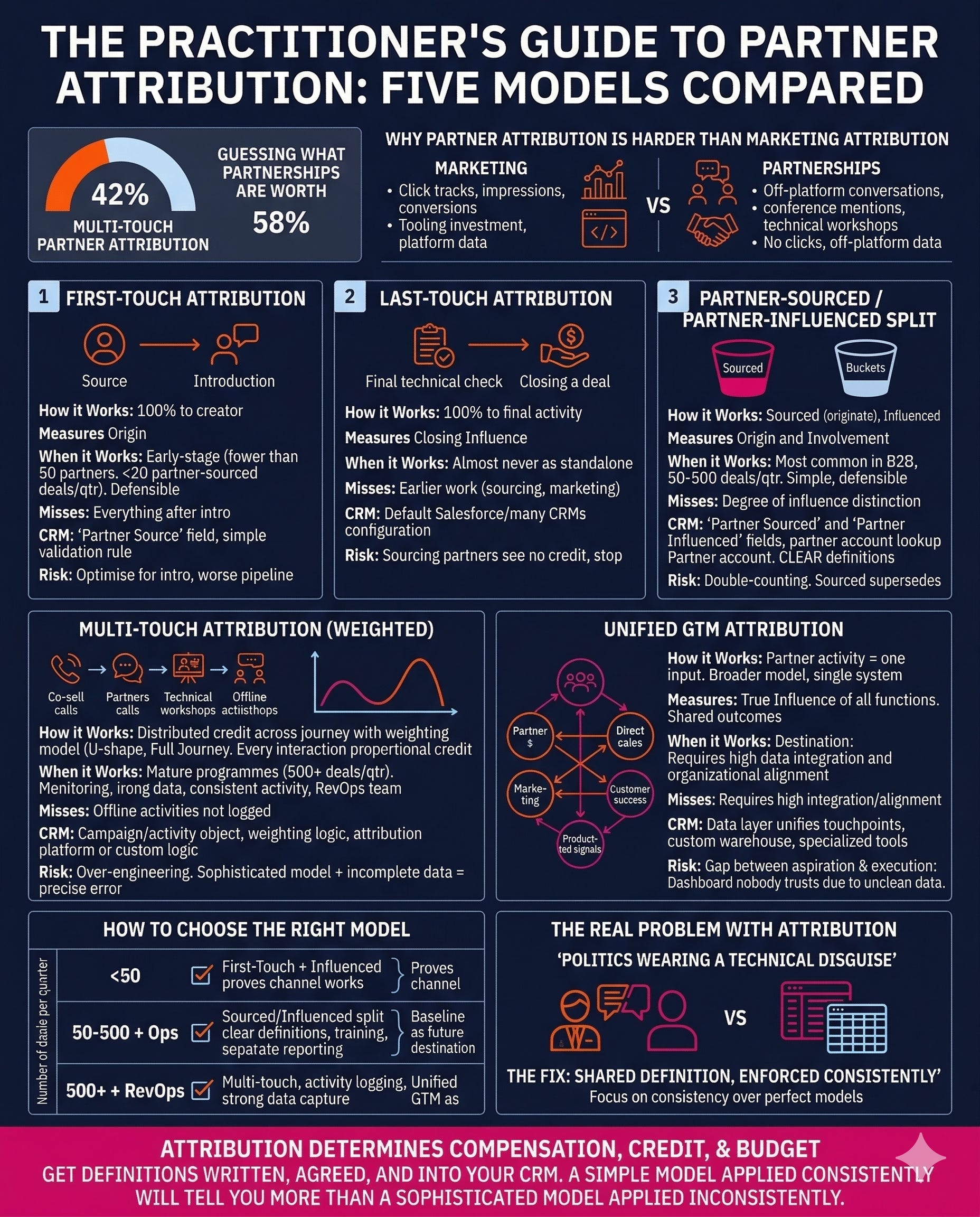
This piece walks through five attribution models for partner programmes - what each one measures, when each one works, and the specific data infrastructure required to make each one function. No vendor pitches. Just the mechanics.
Why partner attribution is harder than marketing attribution
Before we get into the models, it helps to understand why this is specifically difficult for partnerships.
Marketing attribution has had decades of tooling investment. Every major platform tracks clicks, impressions, and conversions. The data is imperfect, but the infrastructure exists.
Partner attribution has almost none of that. A partner introduces your product in a conversation that happens off-platform. They mention you at a conference. They send an email you never see. They do a technical workshop that convinces a buyer your product integrates well with their stack. None of these touches generate a click. None of them show up in your marketing automation platform.
On top of that, partner activity often overlaps with direct sales activity. An AE is working an account. A partner is also working the same account. A co-marketing campaign is running against the same target list. When the deal closes, who gets credit?
The answer depends on what you’re trying to measure - and that’s where the model selection matters.
The five models
1. First-touch attribution
How it works: 100% of credit goes to whoever created the opportunity. If a partner referred the lead that became the deal, the partner gets full credit. If a direct AE sourced it, the partner gets nothing - even if they were deeply involved in winning it.
What it measures: Origin. Where did this deal come from?
When it works: Early-stage partner programmes (fewer than 50 partners, fewer than 20 partner-sourced deals per quarter) where the primary question is “are partners bringing us new business?” If your leadership team just needs to see that the partner channel is generating pipeline, first-touch is simple and defensible.
What it misses: Everything that happens after the introduction. A partner who refers a lead gets full credit. A partner who spends six weeks doing technical enablement, runs a proof of concept, and convinces the buyer to choose you over a competitor gets zero credit because they didn’t make the initial introduction.
CRM implementation: One field on the opportunity object: “Partner Source.” Populated at deal creation. Locked after stage two. This is a single custom field and a validation rule - you can implement it in an afternoon.
The risk: If you only measure sourced, partners learn to optimise for introductions rather than deal quality. You’ll get more referrals and worse pipeline.
2. Last-touch attribution
How it works: 100% of credit goes to whoever was most active at the point of close. If a partner did the final technical validation that got the deal over the line, they get full credit - regardless of who sourced it.
What it measures: Closing influence. Who helped seal this deal?
When it works: Almost never as a standalone model. I include it because some organisations default to it without realising. If your CRM gives credit to whoever is tagged on the opportunity when it moves to closed-won, you’re running last-touch whether you intended to or not.
What it misses: Everything that happened earlier. The partner who made the introduction six months ago gets nothing. The co-marketing campaign that generated the initial interest gets nothing. All of the top-of-funnel and mid-funnel partner activity disappears.
CRM implementation: The default in most Salesforce configurations. Whoever owns the opportunity or is tagged as the partner at close gets the credit. Often this isn’t even a deliberate choice - it’s just how the system was set up.
The risk: Partners who do sourcing work - referrals, introductions, lead generation - see no credit for their contribution and stop doing it. You hollow out your top-of-funnel.
3. Partner-sourced / partner-influenced split
How it works: Two categories. Partner-sourced means the partner originated the opportunity - without them, the deal wouldn’t exist. Partner-influenced means the partner was involved in progressing or closing the deal, but someone else brought it in.
What it measures: Both origin and involvement, separated into two distinct buckets.
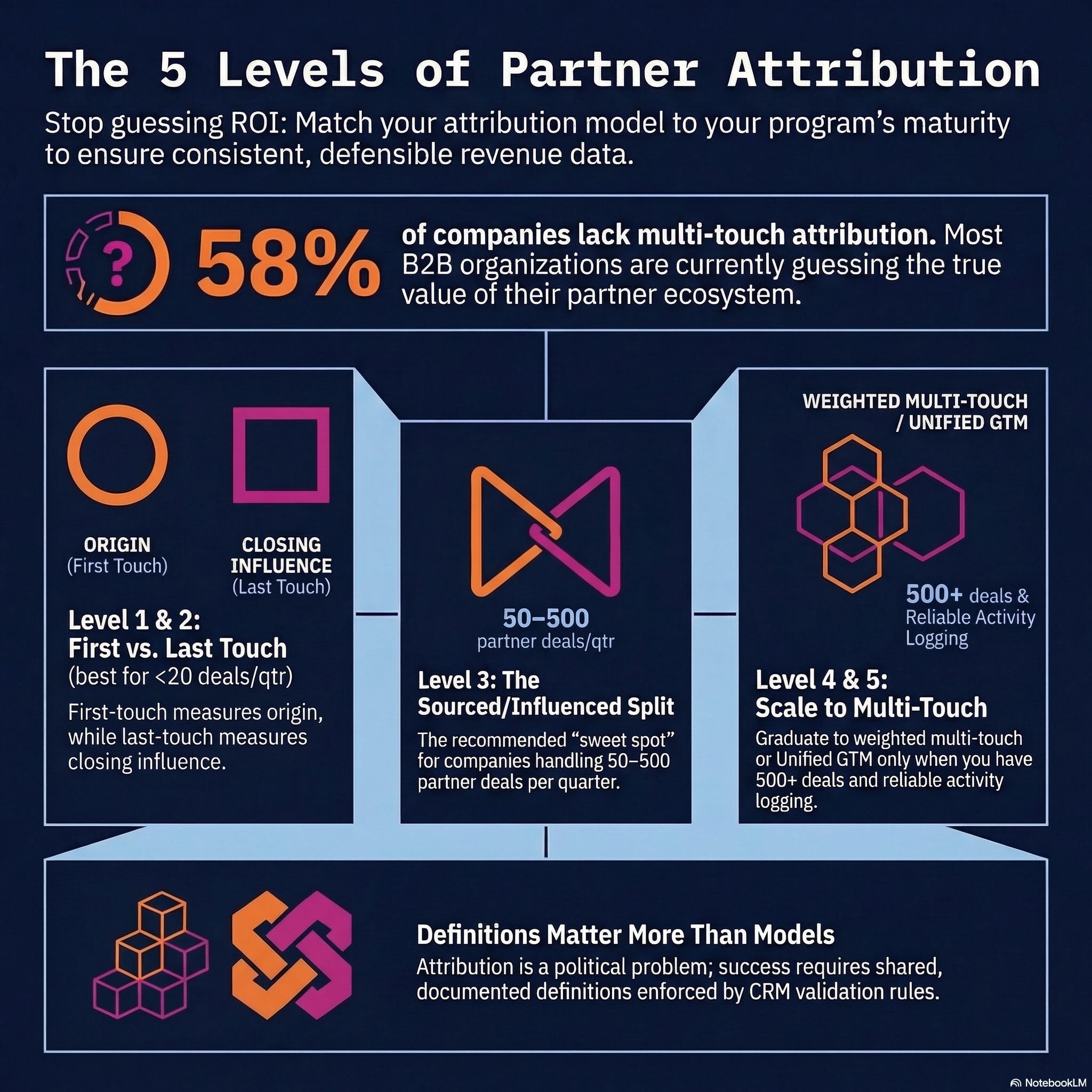
When it works: This is the most common model in B2B partnerships and the one I recommend for most companies between 50 and 500 partner-sourced or influenced deals per quarter. It’s simple enough for sales teams to understand, defensible enough for leadership reporting, and captures partner value at multiple stages.
What it misses: Degree of influence. A partner who does a single co-sell call and a partner who runs a three-month technical evaluation both count as “influenced.” The model doesn’t distinguish between light touch and heavy involvement.
CRM implementation: Two fields on the opportunity object. One checkbox or picklist for “Partner Sourced” (yes/no), one for “Partner Influenced” (yes/no), plus a lookup field linking to the partner account. You’ll need definitions - and this is where most implementations fail. “Sourced” needs a clear test: would this deal exist without this partner? “Influenced” needs a clear test: did the partner perform a documented activity that progressed the deal?
Write those definitions down. Put them in your deal registration rules. Train your AEs on them. If the definitions live in someone’s head rather than in a document, every deal becomes a negotiation.
The risk: Double-counting. If a deal is both “sourced” and “influenced” by the same partner, and you report both numbers to leadership without deduplication, your partner revenue number will be inflated. Decide up front: does sourced supersede influenced? Report them separately, never summed.
4. Multi-touch attribution (weighted)
How it works: Credit is distributed across multiple touchpoints based on a weighting model. Common approaches include U-shaped (40% first touch, 40% last touch, 20% distributed across the middle), W-shaped (30% first touch, 30% lead creation, 30% opportunity creation, 10% distributed), and linear (equal weight across all touches).
What it measures: The full journey. Every partner interaction that contributed to the deal gets proportional credit.
When it works: Mature partner programmes (500+ deals per quarter) with strong data infrastructure, consistent activity logging, and a RevOps team that can maintain the model. If your CRM reliably tracks partner activities - co-sell calls, technical workshops, co-marketing touches, referrals - across the full deal lifecycle, multi-touch gives you the most accurate picture.
What it misses: Offline activity that isn’t logged. If a partner has a conversation at a conference that influences a buyer and nobody records it, it doesn’t exist in the model. Multi-touch is only as good as your activity capture.
CRM implementation: This is where complexity jumps. You need a campaign or activity object that captures every partner touchpoint, linked to the opportunity. You need a weighting model applied across those touchpoints. You need someone maintaining the logic as your partner programme evolves. Most companies implement this through a dedicated attribution platform (Crossbeam, CaliberMind, Dreamdata) or custom Salesforce reports with campaign influence objects.
The risk: Over-engineering. If your data capture is inconsistent - and in most partner programmes it is - a sophisticated weighting model applied to incomplete data produces precise-looking numbers that are precisely wrong. Start with sourced/influenced. Graduate to multi-touch only when your activity logging is reliable.
5. Unified GTM attribution
How it works: Partner activity is treated as one input in a broader attribution model that includes direct sales, marketing, customer success, and product-led signals. No separate “partner attribution” report - partner touches are weighted alongside every other touchpoint in a single revenue attribution system.
What it measures: The true influence of every function and channel on revenue, including partnerships, without treating partners as a separate silo.
When it works: This is the destination, not the starting point. Companies running unified attribution typically have mature RevOps functions, integrated data across CRM, PRM, MAP, and product analytics, and a culture where sales, marketing, and partnerships are measured on shared revenue outcomes rather than siloed metrics.
What it misses: In theory, nothing. In practice, it requires a level of data integration and organisational alignment that most companies haven’t achieved. If your CRM doesn’t talk to your PRM, if marketing and partnerships use different definitions of “influenced,” if your data architecture wasn’t designed to support cross-functional attribution - this model will produce noise, not insight.
CRM implementation: This requires a data layer that unifies touchpoints across all systems. Tools like Crossbeam, HockeyStack, or a custom data warehouse model (Snowflake/BigQuery) feeding a BI layer. Implementation is measured in months, not days, and requires RevOps ownership.
The risk: The gap between aspiration and execution. I’ve seen companies announce they’re moving to unified attribution, buy the tools, run a six-month implementation, and end up with a dashboard nobody trusts because the underlying data was never cleaned first. People, process, data, technology. The sequence applies here too.
How to choose the right model
The model you should use depends on three things: your programme maturity, your data quality, and your organisation’s appetite for complexity.
If you’re running fewer than 50 partner deals per quarter and your CRM has basic partner tracking, start with first-touch for sourced deals and add a single “partner influenced” checkbox. That’s Model 1 plus half of Model 3. You can implement it in a week. It’s imperfect and it’s enough to prove the channel is working.
If you’re running 50-500 partner deals per quarter with a dedicated partner operations function, the sourced/influenced split (Model 3) is your baseline. Invest the time in writing clear definitions, training sales on how to apply them, and building reporting that separates the two categories cleanly.
If you’re running 500+ partner deals per quarter with a mature RevOps function and reliable activity logging, multi-touch (Model 4) gives you a more accurate picture. But only invest in this if your data capture discipline is strong. The model is only as good as the activities logged.
Unified GTM attribution (Model 5) is where the industry is heading, but where almost nobody actually is. Build toward it by improving your data integration incrementally rather than trying to implement it as a single project.
The real problem with attribution
Here’s the part nobody talks about.
Attribution is a political problem wearing a technical disguise. The reason partner attribution is hard isn’t that the models are complex - they’re not. It’s that attribution determines compensation, credit, and budget allocation. When the model changes, someone’s number changes. And that makes people defensive.
The AE who doesn’t want to share credit with a partner will find reasons to argue the partner didn’t really “source” the deal. The partner manager who needs to hit a number will tag deals as influenced when the partner’s involvement was a single email. Marketing will count the same deal in their pipeline report using a different model.
The fix isn’t a better model. It’s a shared definition, enforced consistently, with leadership alignment on what the numbers mean.
Get the definitions written.
Get the definitions agreed.
Get the definitions into your CRM as validation rules, not guidelines.
Then pick the model that matches your maturity and run it.
Attribution doesn’t have to be perfect. It has to be consistent. A simple model applied consistently will tell you more about your partner programme’s value than a sophisticated model applied inconsistently.
Start there.