Everyone is talking about AI. Vendors are selling it. Boards are asking about it. Your competitors are claiming they’ve implemented it. And somewhere in the middle of all that noise, you’re trying to figure out what AI actually means for your business and whether you should be spending money on it right now.
This isn’t a technical deep-dive into neural networks. This is a plain-language breakdown of what AI is, the different types you’ll encounter, how to assess whether your organisation is actually ready for it, and the questions you should be asking before you sign anything.
What AI actually is
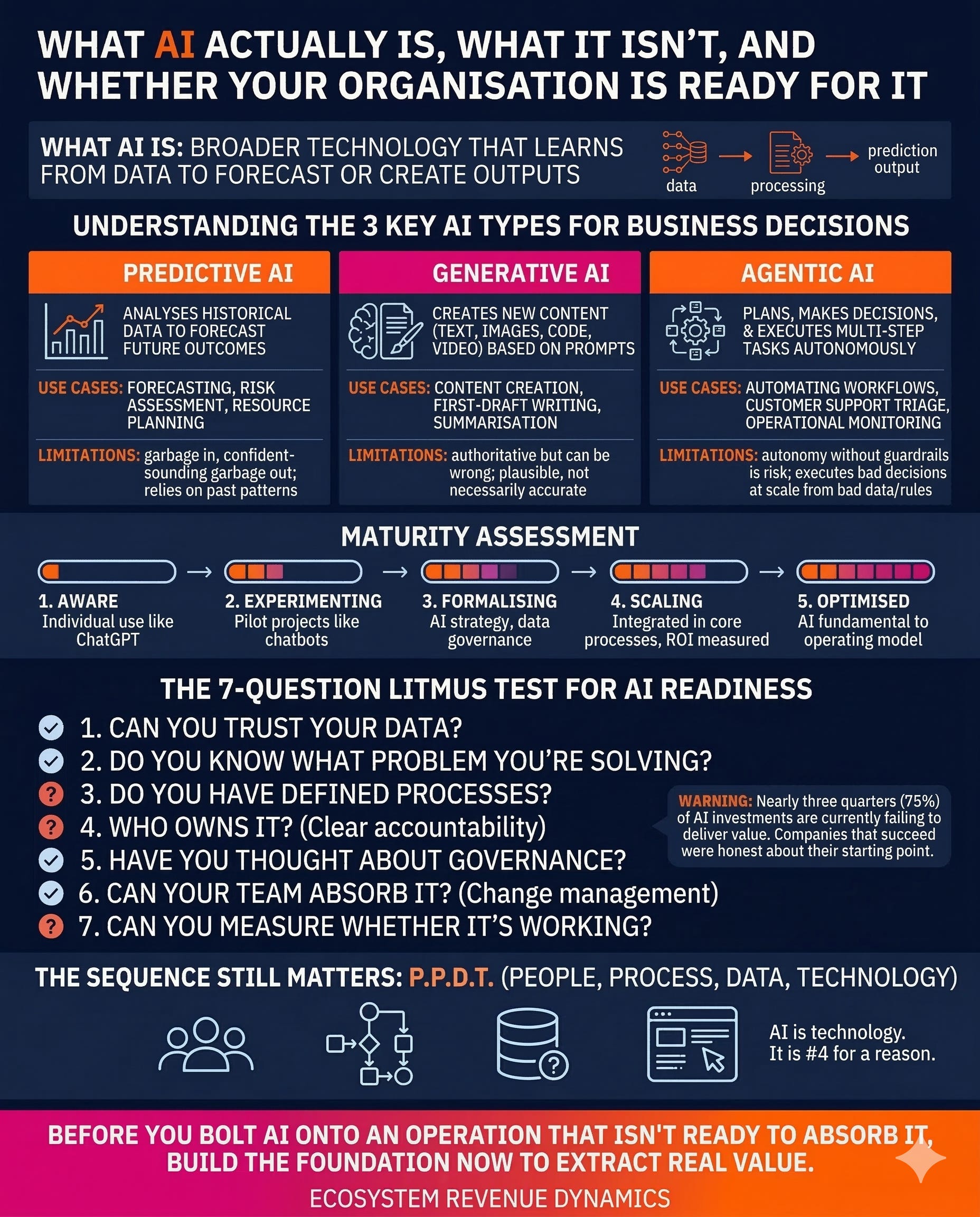
Artificial intelligence is a broad term for technology that can learn from data, identify patterns, and make decisions or produce outputs that would normally require human thinking. That’s it. Everything else is a subcategory.
The confusion starts because “AI” gets used to describe everything from a spreadsheet formula that predicts next quarter’s revenue to an autonomous system that runs your entire customer support operation without human involvement. Those are wildly different things, but they both get called AI.
To cut through this, you need to understand three types that matter right now for business decisions.
The three types you need to know
Predictive AI is the oldest and most established form. It analyses historical data to forecast what’s likely to happen next. If you’ve ever used a lead scoring model, a churn prediction tool, or a demand forecasting system, you’ve used predictive AI.
What it does: looks at past patterns and estimates future outcomes. Which deals are likely to close. Which customers are likely to leave. Which products will sell in Q3. It doesn’t create anything new. It tells you what the data suggests is coming.
Where it works well: forecasting, risk assessment, resource planning, account scoring, pipeline prediction.
Where it falls down: it can only predict based on patterns that already exist in your data. If your data is incomplete, biased, or poorly structured, the predictions will reflect that. Garbage in, confident-sounding garbage out.
Generative AI is what most people mean when they say “AI” in 2026. This is the technology behind tools like ChatGPT, Claude, and image generation platforms. It creates new content - text, images, code, audio, video - by learning patterns from massive datasets and producing original outputs based on prompts.
What it does: produces things that didn’t exist before. Drafts emails. Writes code. Generates marketing copy. Summarises documents. Answers questions in natural language.
Where it works well: content creation, first-draft writing, research synthesis, code generation, customer communication templates, summarisation of large documents.
Where it falls down: it can sound authoritative while being wrong. It generates plausible output, not necessarily accurate output. It has no understanding of your specific business context unless you give it that context. And it raises real questions about data privacy, intellectual property, and quality control that most organisations haven’t answered yet.
Agentic AI is the newest category and the one generating the most hype heading into 2026 and beyond. Unlike predictive AI (which forecasts) and generative AI (which creates), agentic AI acts. It can plan, make decisions, execute multi-step tasks, and use tools - with minimal human oversight.
What it does: autonomously works through complex workflows. An agentic AI system might qualify a lead, check availability, schedule a meeting, send a confirmation, and update your CRM - all without a human touching it.
Where it works well: automating multi-step processes, workflow orchestration, customer support triage, data entry and hygiene tasks, operational monitoring.
Where it falls down: autonomy without guardrails is risk. If an agentic system is working from bad data or poorly defined rules, it will execute bad decisions at scale and at speed. The more autonomous the system, the more important it is that your foundation - your data, your processes, your governance - is solid before you hand it the keys.
The maturity question: where are you actually at?
Understanding the types of AI is step one. Step two is an honest assessment of whether your organisation is ready to use any of them effectively.
Most maturity models use five stages. I’ll simplify them into language that’s actually useful.
Stage 1: Aware. You know AI exists. People in your organisation are using tools like ChatGPT for individual tasks - writing emails, summarising notes, brainstorming. There’s no formal strategy. No governance. No organisational approach. It’s ad hoc and individual.
Most companies think they’re past this stage. Most aren’t. Individual use doesn’t equal organisational readiness.
Stage 2: Experimenting. You’ve run a few pilot projects. Maybe you’ve tested a chatbot, tried an AI-powered sales tool, or used a generative AI platform to produce marketing content. Some pilots worked. Some didn’t. There’s interest from leadership but no formal programme.
This is where the majority of companies actually sit right now. Research suggests most organisations in 2025 and 2026 are stuck here - they’ve had some success with experiments but haven’t figured out how to scale or formalise what they’re doing.
Stage 3: Formalising. You have a defined AI strategy connected to business objectives. There’s budget allocated. You’ve started thinking about data governance, security, and compliance. AI initiatives are coordinated rather than scattered. You’re moving from “we tried some things” to “we’re building a programme.”
Few companies are genuinely here. Many claim to be.
Stage 4: Scaling. AI is integrated into core business processes. It’s not a side project. It’s part of how your teams operate daily. You have governance frameworks, you’re measuring ROI, and you’re making investment decisions based on what’s working and what isn’t.
Stage 5: Optimised. AI is a fundamental part of your operating model. You’re continuously improving, your teams are AI-literate across functions, and you’re using AI to create competitive advantage rather than just efficiency.
Be honest about where you are. The danger isn’t being at Stage 1 or 2. The danger is thinking you’re at Stage 3 or 4 when you’re not - and making investment decisions based on that false assessment.
The litmus test: are you actually ready?
Forget the stages for a moment. Here are seven questions that will tell you more about your AI readiness than any formal assessment.
Can you trust your data? If you asked three people in your organisation for the same number - pipeline value, partner revenue, customer count - would you get the same answer from all three? If not, any AI system you deploy will inherit that inconsistency. AI models are only as reliable as the data they’re trained on and work from.
Do you know what problem you’re solving? “We need to implement AI” is not a problem statement. “Our deal registration response time is too slow and we’re losing partner trust” is a problem statement. If you can’t articulate the specific business problem AI is supposed to address, you’re buying technology in search of a purpose.
Do you have defined processes? AI automates and accelerates. If the process it’s automating is broken, undefined, or inconsistent across teams, AI will automate the dysfunction. You can’t automate what you haven’t defined.
Who owns it? AI initiatives without clear ownership drift. Is this an IT project? A business project? Who is accountable for outcomes? Who decides what gets deployed and what doesn’t? If the answer is vague, the initiative will be too.
Have you thought about governance? Who can access the AI tools? What data are they allowed to use? What are the rules around customer data, intellectual property, and decision-making authority? If you haven’t answered these questions, you’re accumulating risk every day someone uses an AI tool inside your organisation.
Can your team absorb it? Even the best AI tool fails if the people who need to use it don’t understand it, don’t trust it, or don’t change how they work to incorporate it. Adoption isn’t a technology problem. It’s a change management problem.
Can you measure whether it’s working? Before you deploy anything, define what success looks like. Not “we’re using AI” but “we reduced response time by X” or “we increased prediction accuracy by Y.” If you can’t measure the impact, you can’t justify the investment and you can’t tell whether it’s actually delivering value.
If you answered “no” to more than two of those questions, you’re not ready for a major AI investment. You might be ready for small, contained experiments - but you’re not ready to bet operational budget on AI-driven transformation.
That’s not a criticism. It’s a realistic assessment that will save you from joining the growing list of companies that invested heavily in AI and got nothing measurable back. Nearly three quarters of AI investments are currently failing to deliver value. The companies that succeed are the ones that were honest about their starting point.
The sequence still matters
If you’ve read my earlier articles, you know where this ends up. People, Process, Data, Technology. AI is technology. It sits in the fourth position for a reason.
Get your people aligned on what problem you’re solving and who owns it. Get your processes defined and documented so there’s something coherent to automate. Get your data clean, unified, and trustworthy so AI has a reliable foundation to work from. Then - and only then - select the AI technology that serves all three.
This isn’t anti-AI. It’s pro-readiness. The companies that will extract real value from AI over the next two to three years are the ones building the foundation now rather than bolting AI onto an operation that isn’t ready to absorb it.
If you’re honest about where you are, you can build a plan that actually works. If you’re not, you’ll spend money and wonder why nothing changed.