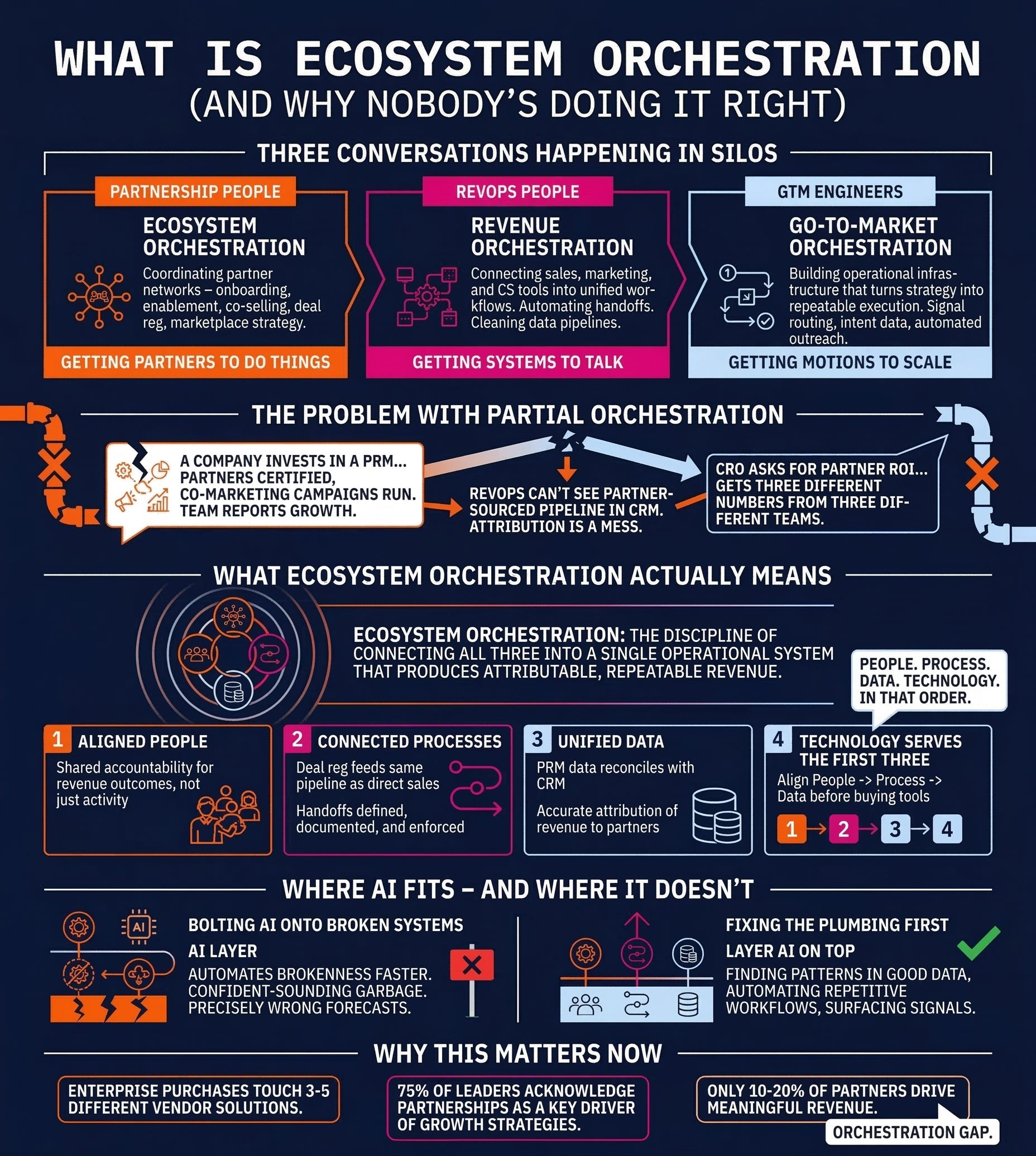
There are three conversations happening right now in B2B that should be one conversation.
The partnerships people are talking about ecosystem orchestration. They mean coordinating partner networks - onboarding, enablement, co-selling motions, deal registration, marketplace strategy. Their version of orchestration is about getting partners to do things.
The RevOps people are talking about revenue orchestration. They mean connecting sales, marketing, and customer success tools into unified workflows. Automating handoffs. Cleaning data pipelines. Their version of orchestration is about getting systems to talk to each other.
The GTM engineers are talking about go-to-market orchestration. They mean building the operational infrastructure that turns strategy into repeatable execution. Signal routing, intent data, automated outreach sequences. Their version of orchestration is about getting motions to scale.
All three groups are right about their piece. None of them are talking to each other. And that gap - between the partner motion, the revenue operation, and the go-to-market execution - is where most B2B companies are quietly losing money.
The problem with partial orchestration
Here’s what I see over and over again.
A company invests in a PRM platform to manage their partner ecosystem. They get partners registered, trained, and certified. They run co-marketing campaigns. They build a portal. The partnerships team reports on partner recruitment numbers and certification rates. Somebody makes a slide about ecosystem growth.
Meanwhile, the RevOps team can’t see partner-sourced pipeline in the CRM because the data doesn’t flow cleanly between the PRM and Salesforce. Deal registration exists, but attribution is a mess. Marketing is running campaigns that overlap with partner activity, and nobody can tell which touch actually influenced the deal. The CRO asks for a report on partner ROI and gets three different numbers from three different teams.
The GTM engineering team has built automated sequences for direct sales that completely ignore the partner channel. Their orchestration layer routes leads, triggers outreach, and scores accounts - but only for the direct motion. Partners exist in a parallel universe.
Each team has orchestrated their piece. The whole system is still broken.
This is the norm, not the exception. I’ve worked inside organisations where the partner team, the RevOps team, and the GTM team each had their own tools, their own data sources, their own definitions of what counts as a qualified opportunity, and their own reporting dashboards that told completely different stories about the same quarter.
What ecosystem orchestration actually means
Ecosystem orchestration - the way I use the term - is not partner management. It’s not revenue automation. It’s not GTM workflow design. It’s the discipline of connecting all three into a single operational system that produces attributable, repeatable revenue.
That means the partner motion, the revenue operation, and the go-to-market execution share the same data foundation, follow aligned processes, and operate within a governance structure that prevents the kind of drift I just described.
Four things have to be true for this to work:
The people are aligned. Partner teams, RevOps, sales, marketing, and customer success are not operating in silos with separate objectives. There is shared accountability for revenue outcomes, not just activity metrics. The partner leader isn’t measured solely on recruitment numbers while the CRO is measured on closed-won. They’re looking at the same pipeline.
The processes are connected. Deal registration feeds into the same pipeline management process as direct sales. Partner-sourced and partner-influenced deals follow the same qualification criteria. Handoffs between partner activity and direct sales activity are defined, documented, and enforced. There isn’t one process for direct and a different, lesser process for channel.
The data is unified. This is where most of it falls apart. If your PRM data doesn’t reconcile with your CRM data, you can’t attribute revenue to partners with any confidence. If your marketing automation platform can’t distinguish between partner-influenced touches and direct touches, your attribution model is fiction. Ecosystem orchestration requires a data architecture where partner activity, direct activity, and customer signals live in the same system of record - or at minimum, are reliably integrated.
The technology serves the first three, not the other way around. I’ve watched companies buy a PRM, a revenue orchestration platform, an intent data tool, and a co-selling platform - then wonder why they still can’t produce a reliable partner ROI number. The tools aren’t the problem. The tools were bought before the alignment, the process, and the data architecture were in place. This is the most common and most expensive mistake in the space.
People. Process. Data. Technology. In that order. Skip a step and you’ve bought yourself an expensive reporting problem.
Where AI fits - and where it doesn’t
I can’t write about operations in 2026 without talking about AI, and I don’t want to. AI is going to change how ecosystem orchestration works. Some of that change is already happening. But the way AI is being sold into this space right now deserves some honest scrutiny.
The promise is compelling. AI agents that automate partner onboarding. Predictive models that score partners based on future revenue contribution rather than historical performance. Automated deal routing that matches opportunities to the right partner based on capability, geography, and past win rates. In-workflow enablement that surfaces the right content at the right moment instead of pointing partners at a static LMS.
Some of this is real and useful today. Vendors using AI for training localisation and customer success support are reporting measurable increases in partner-sold revenue compared to companies without those capabilities. Agentic AI systems that take action and automate workflows across partner ecosystems are accelerating into production.
But here’s where I get cautious.
AI applied to a broken foundation doesn’t fix the foundation. It automates the brokenness faster. If your partner data doesn’t reconcile with your CRM, an AI model trained on that data will produce confident-sounding garbage. If your attribution model is built on incomplete data, a predictive layer on top will give you precise-looking forecasts that are precisely wrong.
AI is not simplifying enterprise technology. It’s shifting where complexity lives. While AI reduces effort at the surface level, it introduces new layers of operational complexity beneath it. Data is fragmented across systems. Integration requires careful orchestration.
That last point is critical and it’s the one most AI vendors skip past in the demo. The prerequisite for AI to deliver value in ecosystem operations is exactly the same foundation I’ve been describing: aligned people, connected processes, clean unified data, and technology that serves all three. AI doesn’t replace that foundation. It depends on it.
I’m not anti-AI. I use it in my own work. I advise clients on where and how to implement it. But I’ve watched enough organisations bolt AI onto broken systems and call it transformation. That’s not transformation. That’s automation of existing dysfunction with a better user interface.
The companies that will get real value from AI in their ecosystem operations are the ones that fix the plumbing first. Get the data clean. Get the processes aligned. Get the teams working from the same definitions. Then layer AI on top and let it do what it’s actually good at - finding patterns in good data, automating repetitive workflows, and surfacing signals that humans would miss.
That sequence matters. Most companies are trying to do it in reverse.
Why this matters now
There’s a reason ecosystem orchestration is becoming urgent rather than optional.
The buying environment has changed. Enterprise purchases now involve multiple vendors, multiple partners, and multiple decision-makers. The average enterprise technology purchase touches three to five different vendor solutions. Linear, single-vendor sales motions are less and less effective. The companies that can orchestrate multi-partner motions - with clean data, clear attribution, and aligned execution - will win the deals that matter.
75% of business leaders now acknowledge ecosystem partnerships as a key driver of their growth strategies. But acknowledging it and operationalising it are very different things. Only 10-20% of partners drive meaningful revenue in most B2B technology companies. The rest consume resources without measurable impact - not because those partners are bad, but because the operational infrastructure to activate them doesn’t exist.
That’s the gap. Not a strategy gap. Not a technology gap. An orchestration gap.
What comes next
This is what Ecosystem Revenue Dynamics is about. Not theory. Not tool reviews. Not vendor-sponsored content dressed up as thought leadership.
I write about how to build the operational systems that make ecosystems actually produce revenue. How to fix the data. How to align the teams. How to design processes that work across direct and indirect motions. How to evaluate AI honestly. How to prove partner ROI to a CFO who doesn’t take your word for it.
If that sounds useful, subscribe. The articles come weekly, and they’re built for people who have to make this stuff work - not people who just have to talk about it.